

Crude and Refined Products Price Review and Outlook
Average global crude oil prices eased slightly by about 1.90%, from US$126.73/bbl to US$124.32/bbl, between 12th and 26th October, the benchmark period for the 1st to 15th November 2026 pricing window.

The moderation in prices was largely attributed to the temporary cessation of military exchanges between the US and Iran ahead of the US mid-term elections. Diplomatic engagements involving senior officials from Saudi Arabia, Turkey, and Pakistan in Tehran also raised hopes of de-escalation, easing geopolitical risk premiums in the international oil market. The escalation of hostilities between Yemen’s Houthis and Saudi Arabia during the period did partially influenced the price movement.

The continued Houthi attacks on Saudi oil infrastructure heightened concerns about the security of supply from the world’s largest crude oil exporter. The US blockade of the Strait of Hormuz targeting Iranian vessels further threatened regional oil flows. However, expectations of a possible ceasefire and the eventual restoration of Gulf oil exports to pre-war levels helped moderate upward pressure on international crude oil prices.
Additional factors contributing to the decline included Russia’s reported supply of approximately 300,000 MT of diesel to the US, with a further 500,000 MT planned for November. Saudi Arabia’s temporary repurposing of selected domestic gas pipelines to facilitate crude transportation and increase export volumes also supported efforts to sustain regional oil supplies.
Despite the slight decline in crude oil prices, all refined products except petrol, which declined by 4.97%, recorded increases. Diesel, LPG, and ATK rose by 3.54%, 21.33%, and 4.05%, respectively. The significant surge in LPG prices, from about US$839.50/MT to US$1,018/MT, was attributed to declining global production and high freight costs. Compared with the same period last year, LPG prices increased by about 121.39% and 114.13% since January. Similarly, diesel prices were 121.23% higher than last year’s levels and 135.54% above January prices.
Consequently, the decline in crude oil prices, alongside the mixed movements in refined product prices, is expected to exert varied pressure on domestic petroleum prices during the 1st to 15th November 2026 pricing window, subject to the cedi’s performance and changes in international product prices.
FuFeX30 and Spot Rates
The Fufex30[1] for the first selling window of November (1st to 15th November 2026) is estimated at GHS11.8500/USD, based on quotations received from oil-financing commercial banks. Moreover, the applicable spot rate for cash sales is estimated at GHS11.7500/USD.

The Ex-Refinery Price Indicator (Xpi)
The Ex-ref price indicator (Xpi) is computed using the referenced international market prices usually adopted by BIDECs, factoring in the CBOD economic breakeven benchmark premium for a given window and converting from USD/mt to GHS/ltr using the Fufex30 for sales on credit and the spot FX rate for sales on cash.
Ex-ref Price Effective 1st to 15th November 2026
| Price Component | Petrol | Diesel | LPG |
| Average World Market Price (US$/mt) | 1,192.6600 | 1,464.8400 | 1,018.5700 |
| CBOD Benchmark Breakeven Premium (US$/mt) | 150 | 250 | 300 |
| Spot FX Rates | 11.7000 | 11.7000 | 11.7000 |
| FuFex30 (GHS/USD) | 11.8000 | 11.8000 | 11.8000 |
| Volume Conversion Factor (ltr/mt) | 1324.50 | 1183.43 | 1000.00 |
| Ex-ref Price (GHS/ltr) Cash Sales | 11.9111/ltr | 16.5298/ltr | 15.4932/kg |
| Ex-ref Price (GHS/ltr) 45-day Credit Sales | 12.0125/ltr | 16.6705/ltr | 15.6251/kg |
| Price Tolerance | +1%/-1% | +1%/-1% | +1%/-1% |
Taxes, Levies, and Regulatory Margins
During the 16th to 31st October 2026 pricing window, taxes, levies and regulatory margins accounted for about 25.12%, 12.22% and 12.49% of the ex-pump prices of petrol, diesel and LPG, respectively. However, following the recent surge in international petroleum product prices, particularly diesel, the Government suspended selected levies and margins equivalent to GH¢2/Ltr and the Energy Sector Shortfall and Debt Repayment Levy (GH¢1/Ltr) on diesel to mitigate the impact on consumers.
| TRM Components | Petrol (GHS/ltr) | Diesel (GHS/ltr) | LPG (GHS/KG) |
| ENERGY SECTOR SHORTFALL AND DEBT REPAYMENT LEVY | 1.95 | 0.93 | 0.73 |
| ROAD FUND LEVY | 0.48 | 0.48 | – |
| ENERGY FUND LEVY | 0.01 | 0.01 | – |
| PRIMARY DISTRIBUTION MARGIN | 0.26 | 0.0 | – |
| BOST MARGIN | 0.12 | 0.0 | – |
| FUEL MARKING MARGIN | 0.09 | 0.0 | – |
| SPECIAL PETROLEUM TAX | 0.46 | 0.46 | 0.48 |
| UPPF | 0.90 | 0.37 | 0.85 |
| DISTRIBUTION/PROMOTION MARGIN | – | – | 0.05 |
| TOTAL | 4.27 | 2.25 | 2.11 |
OMC Pricing Performance: 16th to 31st October 2026
Petroleum product prices have increased considerably across global markets amid heightened geopolitical tensions in the Middle East, particularly the US–Iran war. The conflict has triggered extensive attacks on energy infrastructure across several Gulf countries and disrupted shipping through the Strait of Hormuz, a strategic route through which approximately 20% of global oil supplies transit. The damage to energy facilities and attacks on vessels navigating the Strait have disrupted international supply chains, contributing to tighter supplies and higher petroleum prices.
The war has further worsened global supply conditions amid sanctions on Russian crude oil and petroleum product exports following the Russia–Ukraine war. The US and EU imposed these sanctions to pressure Russia to discontinue its war against Ukraine, further constraining global petroleum supplies.
Although crude oil exports from the Middle East have partially recovered amid ongoing negotiations between the US and Iran to end the conflict and relative stability among Gulf countries, recent attacks by Yemen’s Houthis continue to raise concerns about the sustainability of improvements in global supply conditions.
These supply disruptions have driven significant increases in refined petroleum product prices across international markets. In the US, diesel prices reportedly reached approximately US$6.35 per gallon, representing a 68% increase since the conflict began. Gasoline prices have also risen considerably, reflecting tighter supply conditions and elevated crude oil prices.

Similarly, in Ghana pump prices have risen substantially for all petroleum products. This has prompted Government to introduce measures to cushion consumers, particularly Government suspended the GHS1/Ltr Energy Sector Shortfall and Debt Repayment Levy on diesel to moderate the increase its price, specifically due to its critical role in commercial transport.

The average pump price of petrol across retail outlets declined marginally by 0.22%, from GH¢16.9956/litre to GH¢16.9589/litre, largely reflecting movements in international petroleum product prices. Despite this marginal decline, petrol prices remained 29.27% higher year-on-year and approximately 49.67% above their levels at the beginning of the year.
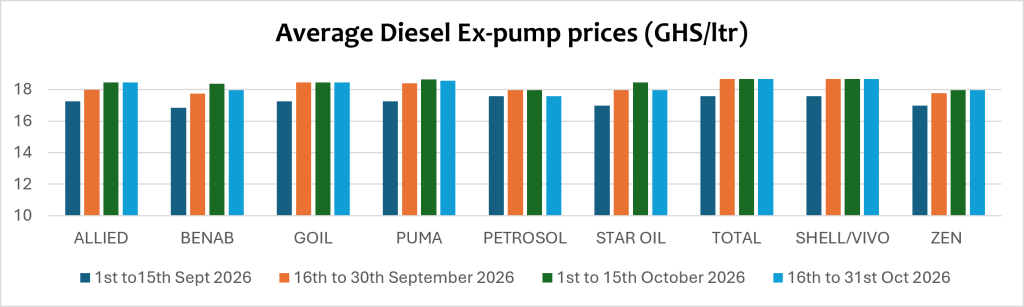
Similarly, the average pump price of diesel declined by 0.84% to GH¢18.2544/litre. Government interventions, including reductions in applicable taxes and levies of approximately GH¢3/litre, helped contain the potential increase in diesel prices. Meanwhile, LPG prices rose significantly to GH¢17.9740/kg, with some OMCs beginning to charge close to GH¢20/kg.
Pump prices are expected to decline slightly in the coming window of 1st to 15th November 2026 reflecting the current declining trend in international prices and the performance of the cedi. However, LPG prices are expected to rise due to the significant surge in LPG prices in the international market.
[1] The Fufex30 is a 30-day GHS/USD forward FX rate used as a benchmark rate by BIDECs ex-ref price estimations.