
Crude and Refined Products Price Review and Outlook
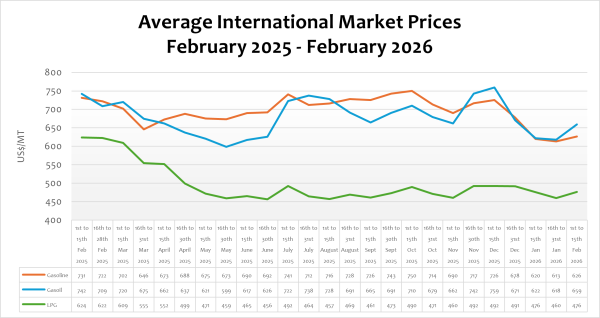
The averages of the international market prices of refined petroleum products in the 12th to 26th January 2026 pricing window are the applicable price benchmarks used in pricing petroleum products from 1st to 15th February 2026 in Ghana. International benchmark prices during the period recorded a marked increase for crude oil and refined petroleum products. This upward trend has been linked to escalating tensions between the United States and Iran, triggered by ongoing protests in Iran over economic hardship, with the U.S. alleging human rights abuses on protestors by Iranian authorities.
International crude oil prices increased by about 7.42%, from an average of USD62.75/bbl to USD67.40/bbl. Despite this short-term rise, year-on-year prices have declined by roughly 16.87%, consistent with the prevailing downward trend driven by excess supply in the global crude oil market.
According to Reuters News, eight OPEC producers—Saudi Arabia, Russia, the United Arab Emirates, Kazakhstan, Kuwait, Iraq, Algeria, and Oman—raised production quotas by about 2.9 million barrels per day from April through December 2025, roughly 3% of global demand, leading to the significant decline in crude prices recorded in recent months.
However, the recent tension between the US and Iran has forced the average prices of petrol, diesel, LPG, and kerosene to rise by 2.12%, 6.73%, 3.66%, and 5.67%, respectively. This marks the first upward adjustment after roughly two months of sustained price declines. On a year-on-year basis, petrol, diesel, and LPG declined by 14.36%, 11.16%, and 23.64%, respectively. Due to the recent rise in international prices, we expect that pump prices in Ghana in the coming window of 1st to 15th February will rise. Consumers should therefore anticipate a moderate rise in petrol, diesel, and LPG prices at the pumps during the first pricing window of February.
FuFeX30 and Spot Rates
The Fufex30[1] for the first selling window of February (1st to 15th February 2026) is estimated at GHS11.2500/USD, based on quotations received from oil financing commercial banks. Moreover, the applicable spot rate for cash sales is estimated at GHS11.0500/USD based on quotations from oil financing commercial banks, representing a depreciation of 0.5%.
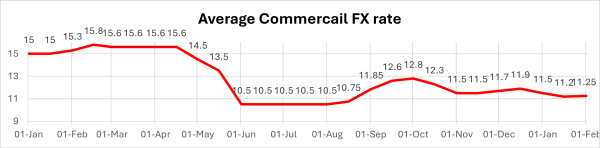
The cedi began the year 2025 at about GHS15/USD, before rising to about GHS15.80/USD. It, however, declined sharply in the second quarter of the year to GHS10.50/USD. The local currency, although volatile throughout the year, was quite stable throughout the second half of the year. This brought predictability in business planning, resulting in the sustained decline in pump prices from an average of about GHS15.4390/Ltr of diesel in January 2025 to GHS12.5350 in December 2025.
The Ex-Refinery Price Indicator (Xpi)
The Ex-ref price indicator (Xpi) is computed using the referenced international market prices usually adopted by BIDECs, factoring in the CBOD economic breakeven benchmark premium for a given window, and converting from USD/mt to GHS/ltr using the Fufex30 for sales on credit and the spot FX rate for sales on cash.
Ex-ref Price Effective 1st to 15th February 2026
| Price Component | Petrol | Diesel | LPG |
| Average World Market Price (US$/mt) | 626.3600 | 659.2500 | 476.3200 |
| CBOD Benchmark Breakeven Premium (US$/mt) | 20 | 200 | 250 |
| Spot FX Rates | 11.0500 | 11.0500 | 11.0500 |
| FuFex30 (GHS/USD) | 11.2500 | 11.2500 | 11.2500 |
| Volume Conversion Factor (ltr/mt) | 1324.50 | 1183.43 | 1000.00 |
| Ex-ref Price (GHS/ltr) Cash Sales | 7.1685/ltr | 8.0230/ltr | 8.0811/kg |
| Ex-ref Price (GHS/ltr) 45-day Credit Sales | 7.2983/ltr | 8.1683/ltr | 8.2275/kg |
| Price Tolerance | +1%/-1% | +1%/-1% | +1%/-1% |
Taxes, Levies, and Regulatory Margins
Total taxes, levies, and regulatory margins within the 16th to 31st January 2026 selling window accounted for about 37.68%, 35.12%, and 16.22% of the ex-pump prices of petrol, diesel, and LPG, respectively. This shows that consumers are overburdened with levies on petroleum products.
| TRM Components | Petrol (GHS/ltr) | Diesel (GHS/ltr) | LPG (GHS/KG) |
| ENERGY SECTOR SHORTFALL AND DEBT REPAYMENT LEVY | 1.95 | 1.93 | 0.73 |
| ROAD FUND LEVY | 0.48 | 0.48 | – |
| ENERGY FUND LEVY | 0.01 | 0.01 | – |
| PRIMARY DISTRIBUTION MARGIN | 0.26 | 0.26 | – |
| BOST MARGIN | 0.12 | 0.12 | – |
| FUEL MARKING MARGIN | 0.09 | 0.09 | – |
| SPECIAL PETROLEUM TAX | 0.46 | 0.46 | 0.48 |
| UPPF | 0.90 | 0.90 | 0.85 |
| DISTRIBUTION/PROMOTION MARGIN | – | – | 0.05 |
| TOTAL | 4.27 | 4.25 | 2.11 |
OMC Pricing Performance: 16th to 31st January 2026
Although the pump price of refined petroleum products declined slightly in 2025 compared to the previous year, pump prices have remained relatively higher compared to 2021 and 2022 prices. This slight decline is largely attributed to the significant appreciation of the cedi against the USD within the period and the sharp fall of international prices of crude and petroleum products. Pump prices of petroleum products rose in 2024 due to the sharp depreciation of the cedi against its major trading currencies. The cedi depreciated by about 40.88% from January to December 2024, resulting in about a 10% increase in the average pump price.
However, the significant appreciation of the cedi against its trading partners in 2025 led to a drop in the pump prices. This brought respite to consumers and motorists, leading to the reduction of transport fares as well as improving LPG adoption. It is worth noting that pump prices have fallen to their lowest in 4 years, since May 2022.
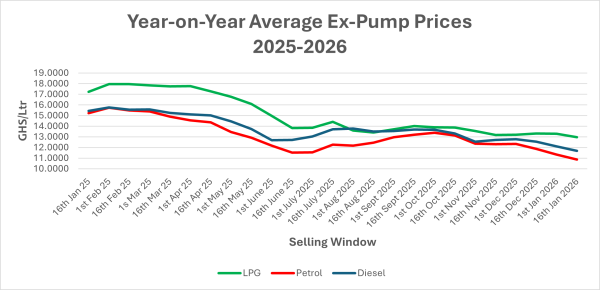
The GHS/USD exchange rate declined from GHS15.10 to GHS10.50 due to various macroeconomic interventions by the government and the Bank of Ghana. Moreover, the international price of crude oil also declined by about 14% due to increased production by both OPEC and non-OPEC nations.
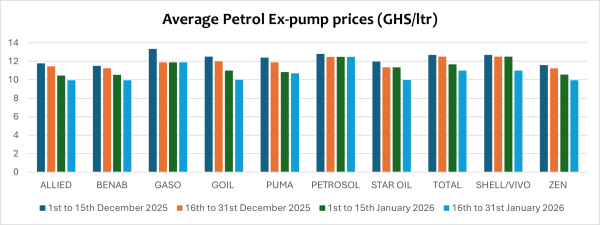
Pump prices of petrol have declined by about 2.76% on average. On a year-on-year basis, pump prices of petrol are down by about 23.80%. Given the relative stability of the cedi, petrol prices are expected to remain stable in 2026, contingent on the stability of global geopolitical and economic circumstances.
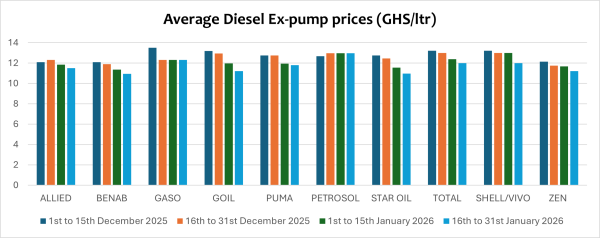
Pump prices of diesel also declined by an average of about 2.41% in 2025. Compared to the same period last year, pump prices of diesel are down by 21.63%. Diesel is currently being sold below GHS12 per liter among some OMCs.
As a result of the recent uptick in global crude and refined product prices, together with a slight weakening of the cedi over the period, pump prices are likely to record a modest increase during the 1st to 15th February 2026 pricing window. Nonetheless, prevailing pump prices continue to be among the lowest seen in over four years.
[1] The Fufex30 is a 30-day GHS/USD forward fx rate used as a benchmark rate for BIDECs ex-ref price estimations.